 Call us now:


Prelude
In early 2020 I was on the Island of Malta and in Egypt doing research for a film production. Being surrounded by so much history inspired me to know my own. Through the study of the courage and testimony of those who came before me, risking their lives for the sake of the cross, I know, on several occasions I gained more courage to take risks for the sake of the cross. Through this study I learned much about the origins of my family name, and the persecution and circumstances that always seem to follow the true testimony of those who proclaim belief in Christ. Here I will list the existing mainstream theory, as well as some newer theories I have come up with while studying.
Introduction
There are 5 theories of where the Enns name came from, and it is possible that several of them, are correct, and that there are several different completely independent Enns family trees. Note that Daren Enns has done some great research on this topic and his work contributed to my research. I am of the opinion that theories 4 and 5 are the only theories substantiated with substantial historical documentation. To understand the theories, it is also important to know of the multiple family lines that existed before the 1600s.
Origin Theories:
- Austria – Boy abandoned by the Enns river
- Austria – Enns Austria (Town)
- Netherlands – East Frisian “Enno or Enne” first names.
- Netherlands – Extinct village of Ens, Netherlands Schokland
- Germany – Endsee Castle
- Switzerland
Documented Pre-1600s Enns Family Lines/Eras (From Oldest to Newest)
- The Lords of Endsee/Ense [700s-1300s] – Steinbach, Westphalia Germany
- The Ense/Varnhagens [1200s-1600s] – Ense, Waldeck, Germany
- The Ens/Shockland Island Era (The Evert/Engelberts) [1300s-1500s] Schockland, Netherlands
- The Frieslend Era [1500s-1600s] Friesland, Netherlands
- The Swiss Entz Family [1300s-1600s] Bern/Thurgau, Switzerland
Theory 1. Boy Abandoned by the Enns River
According to the legend, several hundred years ago, a young boy was abandoned by the Enns River in Austria. Another version of the story says that two boys were found but only one survived until adulthood. The story goes that Dutch Mennonites saved these boys and took them back to the Netherlands. I could not find any original sources for this legend, however I have heard it retold in several locations. (secondary source 1)
My conclusion: Interesting story, but I would like to find out where the story originates.
Theory 2. Enns, Austria (Town)
Enns, Austria is a town in Upper Austria located on the river Enns. It is considered the oldest town in Austria whose charter dates to 1212AD. In 900AD the Enisiburg castle was built as a fortress to protect against invasions. It was later called Ennsegg Palace. Many people in the middle ages gained surnames based on where they were from. For example “Franz from Enns” would become “Franz von Enns” . Any person from the city of “Enns” is technically “von Enns” and the name could have stuck. It is relevant to note that the last name “Enns” is very uncommon amongst Austrians, so I imagine that perhaps a person from Enns, Austria could have migrated to the Netherlands or Germany and stuck with the name. I could not find any original sources for the Enisiburg Castle, but many websites tell this same story. There are no surnames names pre-1800s with the normal “Enns” spelling variations that I could find in Austria, however there are a few with the name “Enzin”. The oldest primary record for a person in Austria with Enzin is Agnes Enzin, who died in 1699.
My conclusion: Enns is not an Austrian surname. It is possible that someone from Austria moved to the Netherlands, but we have no hard evidence.
Theory 3. East Frisian “Enno” or “Enne” first names
Glenn H Penner has done extensive research on Mennonite Genealogies and has done in depth indexing and translation together with Tim Janzen. His theory is that Enns comes from the first name “Enno” or “Enne” in East Frisia. This is a plausible theory. Enno II was count of East Friesland in the 1500s, and although he was strickly against the Anabaptist doctrines, his name proves that Enno was a common first name. Sometimes, in Dutch surnames, an “s” or “z” could be added to the name indicating “zoon” or “son of”. The Enns last name only begins showing up in the Netherlands, however in the 1600s, with less than a hundred records over the course of the century. The oldest primary record I was able to find is for Jan Pieters Ens, who was married in 1611. The second oldest record is from 1615 for Cornelis Claessoon van Ens, for a marriage in Utrecht, which suggests that Cornelis comes from a place called “Ens”. This is compatible with the theory of Schockland.
Theory 4. Extinct Village of Ens (Schokland)
This theory has some very strong evidence and multiple possibilities requiring further research. The Island of Schockland was inhabited for millenia, however in the 1600s, there was a village of Ens and Emmeloord on an Island, which gained the name “Schockland Island”ar around 1750. The island was abandoned in 1859 by the order of King William III.
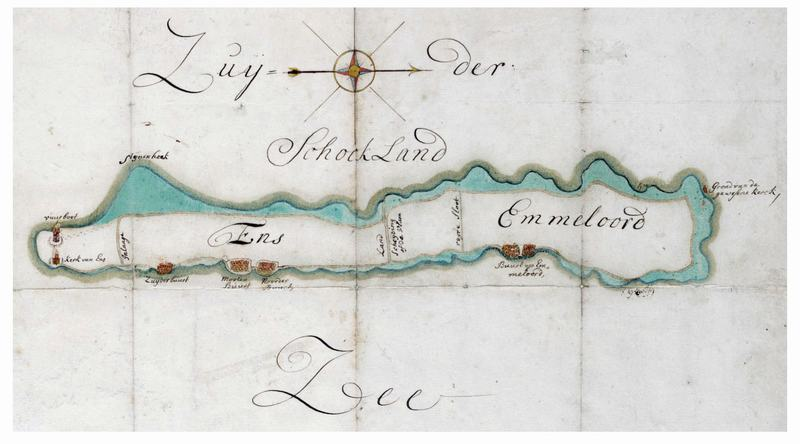
What makes this theory interesting, is that the name “Ens” is derived from the German word “Enedseae” and is mentioned in a dutch document from 793 where the great Frisian missionary Ludger donates some land between Berilsi and Enedseae (referring to the island). According to an article from 1940 in the Wieringer Courant newspaper, there is a legend that three pious sisters founded three churches, in Lisselmuiden, Ens and Nagel, which were built in a line at equal distance one from another. The same article also confirms that the name “Ens” comes from the name “Enedsae” or “Endsea”.
Now there are dozens of Enns names that begin to appear in records associated with the island between 1300s an 1400s. I created a post with links to of the earliest records of the Enns name in the Netherlands along with links for further research.
Germany/Netherlands Link Theory 1 (strong)
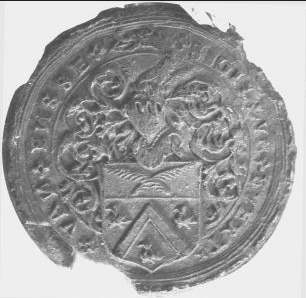
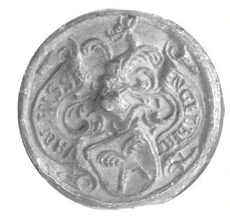
One of the more interesting names is Engelbert van Ense, who was Drost on the island in the village of Ens. He was a councilor of King Phillips II and was accompanied by the Dutch Emperor, Charles the V on his campaigns in Germany and Hungary, and in his fighting against the Turks and also his journey to Italy and Spain. He lived and died in Leeuwarden and had links to Groningen. These are two major towns where Mennonites and the Enns name are found. Engelbert van Ense could be the link between what I call the Schockland Era (1300s-1400s) of the Enns history and the Dutch Mennonite Era (1500s-1600s). Not only this but Engelbert’s Dutch ancestor, mentioned in 1411 was named Evert van Ense, who could be directly related to the German Evert van Ense mentioned in 1372 in Waldeck and associated with the German Waldeck family of Ense. Note, there is about 220km between “Ense”, located in Waldeck Germany and Schockland.
Germany/Netherlands Link Theory 2 (weak)
Let’s get back to Ludger. Ludger is very interesting for several reasons, but also because he could be involved in a weak, but possible theoretical link between the German Ense family (started by Megingaud) and the Shockland Ens.
- Ludger is the first Christian missionary to the Region
- Ludger knew Saint Boniface personally.
- Ludger was a contemporary of German Megingaud of Wurzburg, a student of St. Boniface, and friend of Lullus, Archbishop of Mainz.
- Megingaud of Wurzburg, in 710 was Count of Rothenburg Castle and Endsee (in Germany), and the first in line of a german “Ens” family. In this line, “Endsee” and “Ens” are also interchangeable. This leads to Origin Theory Number 5.